
Zercher Squat Strength Standards
Direct Benchmark Answer (1RM Average)
The average Zercher Squat is 255 lb (116 kg) for men and 138 lb (63 kg) for women.
Compare your one-rep max barbell Zercher squat by bodyweight and sex below. Benchmark your performance from Beginner to Elite.
Zercher Squat Calculator & Tier Assessor
Enter your barbell Zercher squat (bar + plates) to calculate your 1RM and strength tier.
Formula: 100 × (1 + 5 ÷ 30) = 100 × 1.1667 = 116.7 kg
At 82 kg (Male)
Threshold: 115.5 kg
To reach Advanced (156.5 kg)
Your Personalized Reference Standards (at 82 kg)
Modeled 1RM TargetsMale Zercher Squat Standards (LB)
Representative 1RM benchmarks and bodyweight ratios across the global lifter community.
| Strength Level | 1RM Weight (LB) | Percentile |
|---|---|---|
Beginner | 118 lb | Top 95% |
Novice | 179 lb | Top 80% |
Intermediate (Average) | 255 lb | Top 50% |
Advanced | 345 lb | Top 20% |
Elite | 444 lb | Top 5% |
How much should I be able to Zercher Squat? (lb)
Standard target milestones for male lifters
118 lb
0.75× bodyweight
255 lb
1.50× bodyweight
What is the average Zercher Squat?
The average Zercher Squat weight for a male lifter is 255 lb (1RM) (~1.50× bodyweight). Reaching this milestone places you at the Intermediate level, demonstrating solid anterior core bracing, thoracic erector isometric strength, and lower-body force output superior to 50% of lifters.
What is a good Zercher Squat?
Male beginners should aim to lift 118 lb (1RM) (~0.75× bodyweight), which establishes safe elbow-crease cradling, upright posture, and full parallel squat depth.
- Men's Average (1RM):255 lb (116 kg)
- Women's Average (1RM):138 lb (63 kg)
- Ratio to Back Squat:~65%–75%
Zercher Squat Reference Standards by Bodyweight
Modeled 1RM barbell Zercher squat benchmarks across bodyweight classes for men and women.
| Bodyweight (kg) | Beginner | Novice | Intermediate | Advanced | Elite |
|---|---|---|---|---|---|
| 52 kg | 34 kg | 55 kg | 81 kg | 111 kg | 143 kg |
| 56 kg | 37.5 kg | 60 kg | 87.5 kg | 119.5 kg | 154 kg |
| 60 kg | 41 kg | 64.5 kg | 93.5 kg | 127.5 kg | 164.5 kg |
| 67 kg | 45.5 kg | 70.5 kg | 101.5 kg | 138 kg | 178 kg |
| 75 kg | 50 kg | 76.5 kg | 109.5 kg | 148.5 kg | 191 kg |
| 82 kg | 53.5 kg | 81 kg | 115.5 kg | 156.5 kg | 201.5 kg |
| 90 kg | 57.5 kg | 86 kg | 122 kg | 165 kg | 212 kg |
| 100 kg | 61.5 kg | 91.5 kg | 129 kg | 174 kg | 223.5 kg |
| 110 kg | 65 kg | 96 kg | 135 kg | 181.5 kg | 233 kg |
| 125 kg | 69 kg | 101 kg | 141.5 kg | 190 kg | 243.5 kg |
| 140+ kg | 72.5 kg | 105.5 kg | 147 kg | 197 kg | 252 kg |
What Is a Barbell Zercher Squat? (History & Biomechanics)
The barbell Zercher squat is an anterior-loaded compound lower-body exercise in which the barbell is supported directly in the crooks (creases) of the elbows held tight against the mid-torso, rather than resting on the upper trapezius (back squat) or anterior deltoids (front squat).
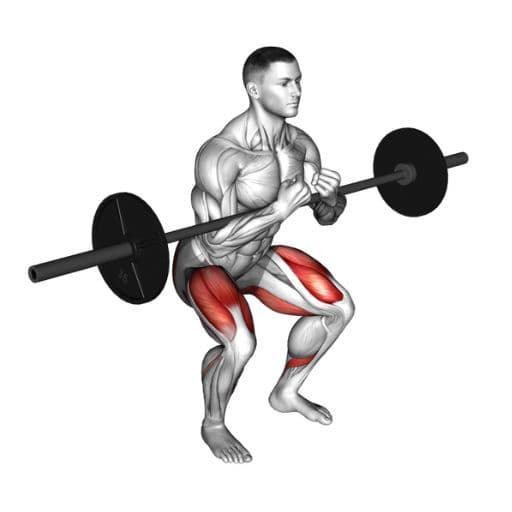 Elbow-Crease Cradle
Muscular Activation & Kinetic Chain Demands
Because the barbell rests 10–12 inches lower than a traditional rack position and sits in front of your center of mass, the Zercher squat recruits a distinct kinetic profile:
- Quadriceps & Adductor Magnus: Vastus lateralis, vastus medialis, vastus intermedius, and rectus femoris drive knee extension from the bottom hole while adductors extend the hips.
- Thoracic Erectors & Upper Back: Rhomboids, middle/lower trapezius, and thoracic erector spinae contract near maximal isometric capacity to prevent upper-back rounding.
- Anterior Core & Biceps Cradle: Rectus abdominis, obliques, biceps brachii, and brachialis generate intra-abdominal pressure and isometric elbow flexion to lock the barbell against the lower sternum.
Named after 1930s St. Louis strongman and powerlifter Ed Zercher, the lift was invented out of necessity when commercial squat racks did not exist in basement gyms. Zercher deadlifted the barbell, rested it on his thighs, hooked his elbows underneath, and squatted from the bottom up. Modern lifters unrack the bar directly from rack pins set at sternum height.
These standards apply strictly to the rack-unracked barbell Zercher squat. They do not mix data with the Zercher deadlift (lifting the bar off the floor in the elbows), Zercher carries, Zercher lunges, or goblet squats.
Zercher Squat Technique, Depth Standard & Elbow Comfort
Comparable strength benchmarks require strict repetition mechanics. Small changes in stance width or elbow alignment directly affect range of motion and leverage.
Sternum-Height Unrack Setup
Set J-hooks at lower-chest height (4–6 in. lower than a back squat). Step in, hook both cubital creases under the barbell, brace the trunk, and stand to unrack.
Elbow Cradle & Grip Options
Lock the shaft deep in the crooks of the elbows. Either clasp your hands (gable grip) to pull the elbows inward or hold separate vertical fists to emphasize upper-back tension.
Stance Width & Inner-Thigh Clearance
Use a shoulder-width or slightly wider stance with 30°–40° toe flare. Push the knees out on descent so your elbows pass cleanly inside your thighs without bottoming out on the quads.
Full Parallel Depth & Upright Lockout
Descend until the hip crease passes below the top of the patella (breaking parallel). Drive the fists and chest upward out of the hole to full hip and knee extension.
A standard 28–29 mm barbell concentrates load along a narrow contact strip over the distal biceps tendon and superficial radial nerve. Wearing 5–7 mm neoprene elbow sleeves or using a thicker 50 mm (2-inch) axle bar / fat grips distributes downward force over a wider surface area, eliminating skin pinching without altering joint moment arms.
Zercher Squat vs. Back Squat vs. Front Squat (Biomechanical Comparison)
While all three movements are bilateral free-weight barbell squats, changing where the load sits relative to your spine and hips alters joint moment arms, postural recruitment, and absolute load capacity.
| Biomechanical Feature | Barbell Back Squat | Barbell Front Squat | Barbell Zercher Squat |
|---|---|---|---|
| Barbell Placement | Upper trapezius (high-bar) or posterior deltoids (low-bar) | Anterior deltoid & clavicular shelf (front rack) | Crooks of the elbows (cubital creases) at lower sternum |
| Center of Mass Height | High (shoulder level) | High (clavicle level) | Low (10–12 in. lower, near mid-torso) |
| Axial Spinal Compression | High direct compressive load down the vertebral column | Moderate-to-high axial load across upper thorax | Reduced cervical/upper-thoracic axial compression; load supported via arms |
| Thoracic & Core Demand | Moderate-to-high lumbar & hip extension demand | High upper-thoracic extension to prevent bar roll | Extreme anterior core bracing & isometric erector spinae tension |
| Wrist & Shoulder Mobility | Requires shoulder external rotation & abduction | High wrist extension, lat, and thoracic mobility required | Minimal wrist or shoulder mobility needed (elbow flexion only) |
| Primary Limiting Factor | Hip and knee extension force at the sticking point | Upper-back extension & quadriceps strength | Isometric trunk stiffness, biceps/elbow cradle tolerance & core bracing |
| Typical Load Ratio | 100% (Baseline reference) | ~80% to 85% of Back Squat 1RM | ~65% to 75% of Back Squat 1RM |
| Best Athletic Carryover | Maximal lower-body force & powerlifting totals | Olympic weightlifting clean recovery & quad hypertrophy | Strongman carries, grappling, deadlift lockout & anterior core resilience |
Zercher Squat vs. Barbell Back Squat
In a conventional Back Squat, the barbell rests directly on the upper back, transmitting compressive force down the spine while allowing the torso to incline forward to recruit the hip extensors. In the Zercher Squat, holding the weight in front of the ribcage creates a powerful anterior flexion torque that demands near-maximal thoracic erector and abdominal bracing. Because upper-back stiffness or elbow-cradle tolerance often limits the lift before leg drive is exhausted, most trained lifters Zercher squat 65% to 75% of their back squat 1RM.
Zercher Squat vs. Barbell Front Squat
Both the Zercher squat and the Barbell Front Squat are anterior-loaded variations that demand an upright torso and high quadriceps recruitment. However, the front squat places the bar high on the clavicles and requires substantial wrist extension, lat flexibility, and shoulder external rotation. The Zercher squat drops the barbell 10–12 inches lower (closer to the hips) and eliminates wrist and shoulder mobility barriers—shifting the challenge to isometric elbow flexion and mid-back tension.
Standards Methodology & Data Transparency
1. Lift & Equipment Standard
Standards apply to a free-weight barbell Zercher squat unracked from sternum-height pins, descending until the hip crease passes below the top of the patella (parallel), and standing to full upright lockout. Total weight includes the 20 kg (44 lb) barbell.
2. Submaximal 1RM Estimation
For sets of 2 to 15 repetitions, the calculator uses the validated Epley (1985) equation: 1RM = Weight × [1 + (Reps ÷ 30)]. Single-rep inputs use the exact weight entered.
3. Reference Benchmark Calibration
Because no powerlifting federation sanctions the Zercher squat as an official contest lift, benchmarks are calibrated from empirical community lift distributions and Dr. Lon Kilgore’s allometric squat curves (~65%–75% of conventional back squat capacity).
4. Mechanical & Conversion Limits
Individual Zercher-to-back-squat ratios vary based on thoracic erector strength, torso-to-femur anthropometry, and forearm pressure tolerance. Avoid using a fixed multiplier to predict back squat 1RM.
Zercher Squat Standards & Technique — Frequently Asked Questions
Answers to the most common questions regarding Zercher squat benchmarks, elbow discomfort, stance setup, and strength programming.
Scientific References & Citations
Our reference benchmarks, submaximal 1RM calculations, and biomechanical analyses are supported by the following sports science publications: