
Squat Calculator: Estimate Your 1RM
Direct 1RM Estimation Tool
Enter any barbell squat working set to calculate your Estimated One-Repetition Maximum (1RM).
Powered by the peer-reviewed Epley equation with instant multi-formula comparison (Brzycki, Lander, Wathen), comprehensive 1RM–12RM tables, and training intensity percentages.
Enter Your Squat Working Set
Input the weight and completed repetitions to calculate your estimated 1RM.
Based on your working set of 140 kg × 5 reps.
How this was calculated:
140 × (1 + 5 / 30) = 140 × 1.1667 = 163.3 kgEpley formula assumes load capacity decreases by approximately 3.33% per completed repetition.
Estimated Squat Rep Max Table (1RM to 12RM)
Theoretical maximum loads for submaximal repetition targets based on your estimated 1RM.
| Repetition Goal | % of 1RM | Estimated Load | Status / Notes |
|---|---|---|---|
| 1RM (1 rep) | 100% | 163.3 kg | Peak 1RM |
| 2RM (2 reps) | 95% | 155.1 kg | Model estimate |
| 3RM (3 reps) | 93% | 151.9 kg | Model estimate |
| 4RM (4 reps) | 90% | 147 kg | Model estimate |
| 5RM (5 reps) | 87% | 140 kg | Your Input Set |
| 6RM (6 reps) | 85% | 138.8 kg | Model estimate |
| 7RM (7 reps) | 83% | 135.5 kg | Model estimate |
| 8RM (8 reps) | 80% | 130.6 kg | Model estimate |
| 9RM (9 reps) | 77% | 125.7 kg | Model estimate |
| 10RM (10 reps) | 75% | 122.5 kg | Model estimate |
| 11RM (11 reps) | 70% | 114.3 kg | Model estimate |
| 12RM (12 reps) | 67% | 109.4 kg | Model estimate |
*Note: Rep max models represent mathematical approximations based on empirical strength curves. Individual muscular endurance, slow-twitch vs. fast-twitch fiber distribution, and technical efficiency can cause actual performance to vary slightly.
Common Squat Training Percentages
Standardized barbell working loads across common periodization intensity zones.
| Intensity | Barbell Load | Training Phase & Primary Focus |
|---|---|---|
| 95% | 155.1 kg | Near-maximal testing / Heavy single primer sets |
| 90% | 147 kg | Heavy strength phase (2–3 rep work) |
| 85% | 138.8 kg | Classic strength building (4–5 rep working sets) |
| 80% | 130.6 kg | Strength-hypertrophy threshold (6–8 rep volume) |
| 75% | 122.5 kg | Volume accumulation & hypertrophic density |
| 70% | 114.3 kg | Speed strength, submaximal dynamic effort (DE) |
| 65% | 106.1 kg | Technique refinement & movement patterning |
| 60% | 98 kg | Active recovery & deload week programming |
*Disclaimer: These values are derived mathematically from your estimated 1RM for programming orientation. They are not medical prescriptions. Always warm up thoroughly and use safety bars or a spotter on heavy sets.
Formula Comparison: 7 Research-Based Equations
Compare how different sports science equations estimate your squat 1RM from the same working set.
| Formula & Author | Mathematical Equation | Estimated 1RM | Difference vs Epley |
|---|---|---|---|
Epley(1985)Primary Boyd Epley | Weight × (1 + Reps / 30) | 163.3 kg | Baseline |
Wathen(1994) Dan Wathen | 100 × Weight / (48.8 + 53.8 × e^(−0.075 × Reps)) | 163.2 kg | -0.1 kg |
Brzycki(1993) Matt Brzycki | Weight × 36 / (37 − Reps) | 157.5 kg | -5.8 kg |
Lander(1985) Jim Lander | 100 × Weight / (101.3 − 2.67123 × Reps) | 159.2 kg | -4.1 kg |
Mayhew et al.(1992) Jerry Mayhew | 100 × Weight / (52.2 + 41.9 × e^(−0.055 × Reps)) | 166.6 kg | +3.3 kg |
Lombardi(1989) V. P. Lombardi | Weight × Reps^0.10 | 164.4 kg | +1.1 kg |
O'Conner et al.(1989) Frank O'Conner | Weight × (1 + 0.025 × Reps) | 157.5 kg | -5.8 kg |
How to Calculate Your Squat 1RM Manually (Worked Example)
You can calculate your estimated squat 1RM manually on paper or any standard phone calculator using the Epley equation:
1RM = Weight × [1 + (Reps ÷ 30)]Where Weight is the total barbell load lifted (bar + plates) and Reps is the number of completed repetitions before technical failure.
- Divide reps by 30:5 ÷ 30 = 0.1667
- Add 1 to the multiplier:1 + 0.1667 = 1.1667
- Multiply by working weight:140 × 1.1667 = 163.3 kg
- Divide reps by 30:5 ÷ 30 = 0.1667
- Add 1 to the multiplier:1 + 0.1667 = 1.1667
- Multiply by working weight:315 × 1.1667 = 367.5 lb
How Accurate Is an Estimated Squat 1RM?
Submaximal 1RM estimation is widely used in competitive powerlifting and collegiate athletics because testing a true 1RM imposes substantial central nervous system fatigue and elevated injury risk. However, mathematical estimation equations are not equally accurate across all repetition counts.
1 to 5 Repetitions
The “sweet spot” for squat 1RM prediction. In this range, energy is supplied almost entirely by the phosphagen (ATP-CP) system. Neuromuscular recruitment matches a maximal attempt with minimal technical degradation.
6 to 10 Repetitions
Reliable for general training planning. However, anaerobic glycolysis generates intramuscular acidosis, and cardiovascular fatigue begins influencing performance alongside pure maximal force production.
11 to 15+ Repetitions
Muscular endurance and cardio conditioning become primary limiters. Spinal erectors and breathing mechanics fatigue before quadriceps or glute failure, frequently leading to under- or over-estimated maximal values.
Estimated 1RM vs. Actual Tested 1RM
Understanding the distinction between an estimated 1RM and an actual tested 1RM is essential for both injury prevention and structured athletic progression.
Estimated 1RM (Mathematical Model)
Calculated from a submaximal set (such as 3–8 reps). It represents your theoretical peak strength capacity on that day based on mathematical regression equations.
- Low Injury Risk: Eliminates catastrophic failure under maximum absolute loads.
- Weekly Tracking: Can be assessed during normal training without peaking cycles.
- Programming Basis: Ideal for calculating working set percentages and RPE benchmarks.
Actual Tested 1RM (Competition Lift)
The heaviest load you have physically unracked, descended to parallel with, and stood up with to full lockout in real life.
- Absolute Ground Truth: Verifies actual technical competence under maximal stress.
- Psychological Demand: Requires intense mental focus, arousal, and confidence under the bar.
- High Recovery Cost: Imposes prolonged systemic fatigue on spinal stabilizers and the CNS.
Why your actual squat 1RM may differ from the calculation:
About the Barbell Back Squat & Muscular Activation
The barbell back squat is widely recognized as the premier lower-body compound movement in human performance testing. Estimating your 1RM requires consistent biomechanics and depth on every working set.
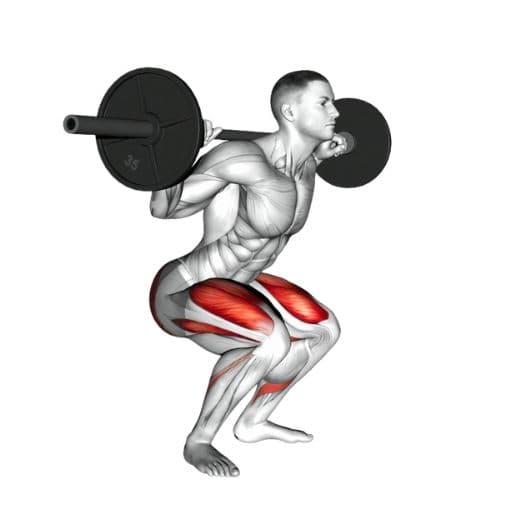 Muscular Target
Primary Muscular Movers & Stabilization
Every repetition recruits multiple major muscle groups simultaneously:
High-Bar vs. Low-Bar Barbell Squat: Does Bar Placement Change 1RM?
The calculation formulas apply equally to high-bar and low-bar squats. However, because low-bar positioning places the bar lower across the posterior deltoids, it necessitates greater forward torso inclination to keep the barbell centered over the midfoot. This shortens the moment arm at the knee joint and engages greater mechanical advantage from the powerful posterior chain (gluteus maximus and adductor magnus), allowing most lifters to lift approximately 5% to 10% more weight than in a high-bar squat. If you are calculating a 1RM for programming, keep your bar position consistent between your submaximal set and planned target.
Frequently Asked Questions (FAQ)
Common questions about squat 1RM estimation, sports science formulas, and practical training applications.
The calculator uses submaximal set data—the weight you squatted and the number of repetitions completed—and applies established mathematical formulas (primarily the Epley equation: 1RM = Weight × [1 + Reps / 30]). This estimates the theoretical maximal force you can produce for a single repetition without the injury risk of a true 1RM attempt.
Scientific References & Citations
Every mathematical formula and accuracy threshold in this calculator is derived from peer-reviewed sports science and biomechanics publications: