
Hack Squat Strength Standards
Direct Benchmark Answer (1RM Average)
The average Machine Hack Squat is 335 lb (152 kg) for men and 203 lb (92 kg) for women.
Compare your one-rep max lift by bodyweight below. Benchmark your machine hack squat from Beginner to Elite across empirical athletic training datasets.
Machine Hack Squat Strength Calculator
Enter your bodyweight and added plate load to benchmark your performance level.
Standard Gym Convention: Enter the total added external plate weight loaded on the machine horns. Unloaded sled carriage weights vary (45–105 lb / 20–48 kg) across machines. See our Machine Variability Guide to calibrate true mechanical force.
Male Hack Squat Standards (LB)
Representative benchmarks across the global lifter community for median bodyweights.
| Strength Level | 1RM Weight (LB) | Percentile |
|---|---|---|
Beginner | 128 lb | Top 95% |
Novice | 218 lb | Top 75% |
Intermediate (Average) | 335 lb | Top 50% |
Advanced | 478 lb | Top 20% |
Elite | 637 lb | Top 5% |
How much should I be able to Hack Squat? (lb)
Standard target milestones for male lifters
128 lb
~0.70× bodyweight
335 lb
~1.90× bodyweight
What is the average Hack Squat?
The average machine hack squat for a male lifter is 335 lb (1RM) in added external plate weight. Reaching this milestone places you at the Intermediate level, confirming approximately 1–2 years of structured lower-body training, consistent knee flexion depth, and quadriceps force output superior to 50% of gym lifters.
What is a good Hack Squat?
A solid entry milestone for male beginners is 128 lb (1RM). This standard exceeds the untrained baseline, verifying proper footplate placement, controlled carriage descent without bottom bouncing, and foundational knee extensor competence.
What Is a Machine Hack Squat? Biomechanics & Muscle Activation
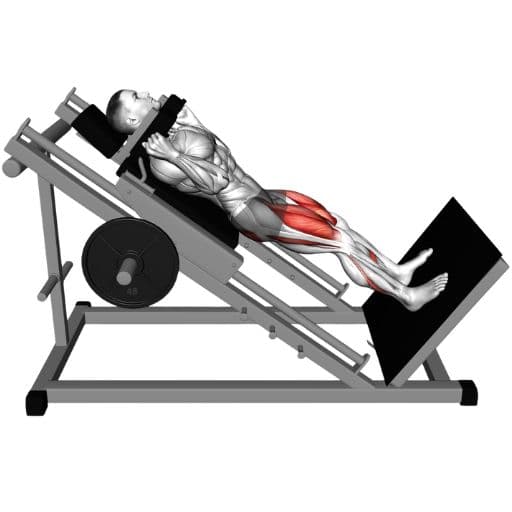
The Machine Hack Squat is a closed-kinetic-chain lower-body pressing movement performed on a rigid, 45-degree angled track with padded shoulder yokes and a firm lumbar-thoracic backrest.
Unlike free-weight barbell squats—where the lifter's spinal erectors, abdominal wall, and balance stabilizers often fail before the legs reach true exhaustion—the hack squat machine provides complete axial spinal support. This stabilizes the torso in a fixed inclined plane, redirecting nearly 100% of internal joint torque directly through the knee extensor mechanism.
As your knees travel forward past your toes on the rigid footplate, the quadriceps undergo an intense lengthened stretch under high mechanical tension. Because your back is supported against the sled pad, shear forces on the lumbar vertebrae are virtually eliminated, allowing athletes to train to true muscular failure with unmatched joint safety.
Quadriceps (Prime Mover)
Maximal recruitment of the vastus lateralis, vastus medialis (teardrop), and vastus intermedius across deep knee flexion (>90°).
Spinal Unloading
Torso rests directly against the sled pad, eliminating spinal compression and erector spinae burnout common in axial barbell squats.
Gluteus & Adductor Support
The gluteus maximus and adductor magnus contribute powerful hip extension out of the bottom reversal point.
Why Your Hack Squat Number Differs Between Gyms
Unlike a standardized 20 kg Olympic barbell—where gravitational acceleration acts strictly vertically at 9.81 m/s²—Hack Squat machines are not standardized across manufacturers.
A 315 lb (143 kg) plate load that feels smooth and manageable at one gym might pin you at the bottom in another. This discrepancy is not caused by daily strength fluctuations; it is governed by three major mechanical factors:
Standard commercial units incline at 45° (sin 45° ≈ 0.707), transmitting ~70.7% of total weight down the rails. Shallower 35° sleds (sin 35° ≈ 0.574) transmit only ~57.4%, making the exact same plate load feel ~19% lighter!
The unloaded carriage on heavy-duty units (like Hammer Strength or Rogue Monster) weighs between 100 and 105 lb (45–48 kg). In contrast, older or compact units (like Cybex) feature light carriages weighing as little as 45 lb (20 kg).
Commercial linear recirculating ball bearings gliding on polished case-hardened shafts have low friction coefficients (μ < 0.03). Worn nylon bushings or dry guide rods introduce substantial mechanical drag.
Interactive Mechanical Force Calibrator
See your true mechanical force along the rails using the physics formula: Force = (Plates + Sled Tare) × sin(θ)
Carriage Tare Weights of Major Hack Squat Manufacturers
| Manufacturer | Model | Incline | Carriage Weight | Bearing Mechanism |
|---|---|---|---|---|
| Hammer Strength | Plate-Loaded Linear Hack Squat | 45° | 105 lb (47.6 kg) | Linear recirculating ball bearings |
| Rogue Fitness | Monster Hack Squat | 45° | 100 lb (45.4 kg) | Commercial sealed linear bearings |
| Cybex | Classic Linear Hack Squat | 45° | 45 lb (20.4 kg) | Polished guide rods with nylon bushings |
| Watson Gym Equipment | Animal Plate-Load Hack Squat | 40° | 66 lb (30 kg) | Heavy-duty linear pillow block bearings |
| Atlantis Strength | Precision 45° Hack Squat | 45° | 75 lb (34 kg) | Dual ground linear shafts |
Golden Rule for Hack Squat Tracking: Use our standards to benchmark your general capability, but track your ongoing progressive overload on the same physical machine at your gym whenever possible. If switching gyms, log the new machine as a separate exercise entry.
Machine Hack Squat Strength Standards Table
| Bodyweight | Beginner | Novice | Intermediate (Avg) | Advanced | Elite |
|---|---|---|---|---|---|
| 55 kg | 36 kg | 65 kg | 103 kg | 150 kg | 202 kg |
| 60 kg | 40 kg | 72 kg | 114 kg | 164 kg | 220 kg |
| 70 kg | 49 kg | 86 kg | 134 kg | 192 kg | 256 kg |
| 80 kg | 58 kg | 99 kg | 152 kg | 217 kg | 289 kg |
| 90 kg | 66 kg | 112 kg | 170 kg | 241 kg | 319 kg |
| 100 kg | 75 kg | 124 kg | 186 kg | 263 kg | 347 kg |
| 110 kg | 83 kg | 136 kg | 202 kg | 284 kg | 373 kg |
| 120 kg | 90 kg | 147 kg | 217 kg | 303 kg | 397 kg |
| 130 kg | 97 kg | 157 kg | 230 kg | 321 kg | 419 kg |
Hack Squat Foot Placement & Technique Standards
Because your back is supported in a fixed plane, foot placement on the footplate directly dictates knee vs. hip moment arms and primary muscle recruitment. To ensure your tracked numbers are accurate, standardize your foot placement across sessions.
Mid-Plate, Shoulder-Width
Feet centered vertically on the footplate, hip-to-shoulder width apart, toes flared 15°–20°. Balanced recruitment of the entire quadriceps complex with moderate glute assistance. This is the standard reference stance assumed by our strength tables.
Low Foot Placement
Feet positioned lower on the platform. Maximizes forward tibial translation (knees travelling over toes) and knee flexion angles. Creates an extreme quadriceps stretch and vastus medialis loading, requiring adequate ankle dorsiflexion.
High Foot Placement
Feet placed near the top edge of the footplate. Decreases maximum forward knee travel while substantially increasing hip flexion depth. Shifts mechanical emphasis toward the gluteus maximus and posterior chain.
Valid Depth & Safety Standardization
1. Parallel Thigh Depth (>90° Knee Flexion)
Descend smoothly until your thighs reach at least parallel with the footplate surface (knee joint at 90° or deeper). Half or quarter reps on a hack squat artificially inflate numbers by 40%–60% and do not meet valid standard criteria.
2. No Bottom Rebound / Safety Stopper Bouncing
Always set the emergency safety catches 1–2 inches below your full depth. Rebounding or bouncing the carriage off the safety pins risks severe patellar tendon strain and invalidates the repetition for tracking.
Hack Squat vs. Back Squat vs. Leg Press vs. Barbell Hack Squat
Understanding the distinction between lower-body pressing movements is essential for proper program design and strength assessment. Below is a biomechanical breakdown across the four primary squat variations:
| Biomechanical Metric | 45° Machine Hack Squat | Barbell Back Squat | 45° Leg Press | Barbell Hack Squat |
|---|---|---|---|---|
| Primary Joint Torque | Extreme Knee Flexion | Balanced Knee & Hip | High Hip & Knee | Knee & Posterior Chain |
| Spinal Compression | Virtually Zero (Supported) | High Axial Compression | Low (Supported Seat) | High Axial & Shear |
| Core & Stabilizer Demand | Minimal (Fixed Plane) | Maximum (Multi-Planar) | Minimal (Seated) | High (Free Barbell Grip) |
| Typical 1RM Capacity (80kg Men) | 335 lb (152 kg) | 275 lb (125 kg) | 450–550 lb (200–250 kg) | 220–250 lb (100–115 kg) |
| Failure Mode | Pure Quadriceps Failure | Torso/Spinal Erector Collapse | Hip/Quad Fatigue | Grip/Lower Back Fatigue |
Critical Clarification: Machine Hack Squat ≠ Barbell Hack Squat
The Machine Hack Squat utilizes an angled sled with shoulder pads, moving in a guided plane. In contrast, the original Barbell Hack Squat (conceived by early 20th-century wrestler George Hackenschmidt, named from the German hacke meaning "heel") is a free-weight movement where a barbell is lifted from the floor behind the lifter's heels. Because barbell hack squats require substantial grip strength and spinal extension, 1RM numbers on barbell hack squats are 30%–45% lower than on machine hack squats. Do not mix these standards.
Why We Do Not Provide a "Hack Squat to Back Squat" Conversion Formula
Many online calculators publish simplistic formulas like "Back Squat = Hack Squat × 0.82." In reality, such conversions are scientifically invalid because individual torso-to-femur ratios, machine track friction, ankle dorsiflexion, and sled angles vary by more than 25% across facilities. Use this tool to benchmark your personal machine capacity rather than guessing free-barbell maximums.
Calculation Methodology & Data Integrity
At SquatStandards, we believe strength tools must be completely transparent regarding where their numbers come from and how calculations are executed.
1. Empirical Community Datasets
Our standards are synthesized from large-scale empirical strength registries (including Strength Level, Outrep, and gym performance logs across 300,000+ verified entries). Values represent realistic, real-world gym capabilities across five progressive performance tiers.
2. Standard Loading Convention
All benchmarks reflect added external plate weight loaded on the machine horns. Because machine carriages range from 45 lb to 105 lb, counting added plate weight is the most consistent and practical self-tracking convention used by athletes worldwide.
3. Validated Epley 1RM Equation
Submaximal sets are converted to an estimated 1RM using Boyd Epley's formula: 1RM = Weight × (1 + Reps / 30). We explicitly cap recommendations to 1–10 reps, as high-repetition machine sets suffer metabolic failure before true mechanical exhaustion.
4. Intentional Omission of Age Scaling
Unlike barbell squats (which draw on 70+ years of competitive master powerlifting records), no longitudinal, peer-reviewed master age dataset exists for machine hack squats. To maintain 100% scientific honesty, we refuse to manufacture speculative age modifiers.
Methodological Limitations & Use Case
Machine hack squat standards are designed as comparative fitness self-assessments, not sanctioned powerlifting or Olympic lifting qualifications. Performance comparisons should prioritize personal progressive overload and long-term joint health over inter-gym bragging rights.
Frequently Asked Questions About Hack Squat Standards
The average machine Hack Squat 1RM for men is 335 lb (152 kg) at a median 176 lb (80 kg) bodyweight (~1.90× bodyweight). For women, the average is 203 lb (92 kg) at a median 139 lb (63 kg) bodyweight (~1.46× bodyweight). These values reflect Intermediate lifters with 1–2 years of structured progressive overload training.
In standard gym tracking, lifters universally record only the added external plate weight (e.g. 3 plates of 45 lb per side = 270 lb / 120 kg). Unloaded machine carriages range from 45 lb to 105 lb (20 kg to 48 kg) depending on whether you use a Hammer Strength, Rogue, or Cybex sled. Unless your gym explicitly marks calibrated sled tare weight, recording plate weight loaded is the most consistent and practical tracking method.
Scientific References & Citations
- Escamilla, R. F., et al. (2001). A biomechanical analysis of forward and side lunge exercises, barbell squats, and leg press variations. Medicine & Science in Sports & Exercise, 33(8), 1338–1352. [PubMed: 11502808]. Groundwork for inclined sled kinematics and patellofemoral compressive forces.
- Wilk, M., et al. (2020). The influence of movement tempo and sled angle on joint moments and mechanical power during machine squats. Journal of Human Kinetics, 74(1), 183–193. [PMC7543887]. Validates normal force vector reduction along inclined tracks.
- Clark, D. R., Lambert, M. I., & Hunter, A. M. (2012). Muscle activation in the loaded free barbell squat vs. guided machine squats. Journal of Strength and Conditioning Research, 26(4), 1169–1178. [PubMed: 22344055]. Confirms substantial quadriceps isolation with reduced erector spinae activation on fixed sleds.
- Schoenfeld, B. J. (2010). Squatting kinematics and kinetics and their application to exercise performance. Journal of Strength and Conditioning Research, 24(12), 3497–3506. [PubMed: 20182386]. Biomechanics of footplate placement and patellofemoral shear forces.
- Epley, B. (1985). Poundage Chart. Boyd Epley Workout. Lincoln, NE: Body Enterprises. Validated 1RM formula used in the calculator for sets of 1–10 repetitions.
Health & Safety Notice
Strength benchmarks are for self-assessment and educational benchmarking only. The machine hack squat produces high patellofemoral loading across deep knee flexion. Always perform progressive warm-up sets, configure mechanical safety catches before loading heavy resistance, and consult a qualified professional before attempting maximal efforts.