
Front Squat Strength Standards
Direct Benchmark Answer (1RM Average)
The average Front Squat is 231 lb (105 kg) for men and 138 lb (63 kg) for women.
Compare your one-rep max lift by bodyweight and age below. Benchmark your front squat from Beginner to Elite across peer-reviewed athletic datasets.
Male Front Squat Standards (LB)
Representative benchmarks across the global lifter community for median bodyweights.
| Strength Level | 1RM Weight (LB) | Percentile |
|---|---|---|
Beginner | 116 lb | Top 95% |
Novice | 168 lb | Top 75% |
Intermediate (Average) | 231 lb | Top 50% |
Advanced | 304 lb | Top 20% |
Elite | 384 lb | Top 5% |
How much should I be able to Front Squat? (lb)
Standard target milestones for male lifters
116 lb
~0.60× bodyweight
231 lb
~1.30× bodyweight
What is the average Front Squat?
The average front squat for a male lifter is 231 lb (1RM). Reaching this milestone places you at the Intermediate level, confirming approximately 1–2 years of structured resistance training, healthy thoracic spine extension, upright squat mechanics, and quad-dominant force output superior to 50% of lifters.
What is a good Front Squat?
A solid entry milestone for male beginners is 116 lb (1RM). This standard exceeds the untrained population baseline, verifying sound front-rack positioning, adequate wrist and lat mobility, and foundational knee extensor competence.
Biomechanical Profile of the Front Squat
The barbell front squat is a premier closed-kinetic-chain compound exercise where the load rests securely across the anterior deltoids and clavicles in a “front rack” position. This anterior bar placement shifts your center of gravity forward, demanding an exceptionally upright torso (65°–85° angle) and generating maximum quadriceps recruitment while minimizing lumbar shear strain.
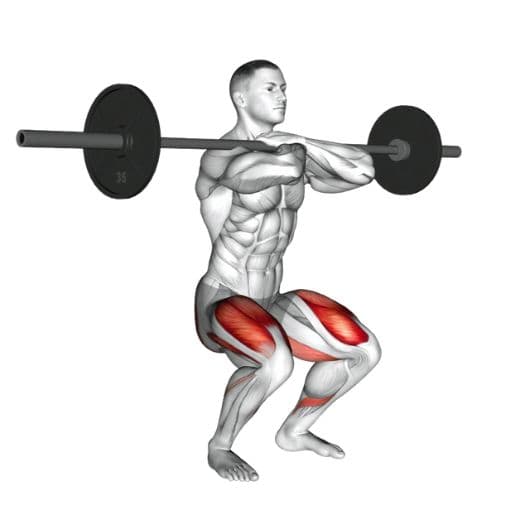 Quad Dominant
Target Muscular Recruitment & Mechanics
As illustrated, the front-loaded barbell dramatically alters muscle activation relative to back squatting:
- Primary Knee Extensors: Quadriceps Femoris (rectus femoris, vastus lateralis, vastus medialis) experience continuous mechanical tension due to long moment arms at the knee joint.
- Thoracic Extensors: Rhomboids, middle trapezius, and thoracic erector spinae contract isometrically to prevent upper-back rounding under the anterior load.
- Anterior Core Bracing: Rectus abdominis and obliques resist thoracic flexion, acting as a structural pillar supporting the barbell shelf.
The 80%–85% Diagnostic Ratio
In competitive resistance training, lifters typically front squat 80% to 85% of their back squat 1RM. The limiting threshold is rarely quadriceps strength alone; rather, it is thoracic spine rigidity, wrist/shoulder mobility, or core posture under load. If your front squat is below 75% of your back squat, incorporating dedicated front-rack mobility drills and upper-back hypertrophy will directly unlock greater back squatting power.
Front Squat Standards Reference Tables
Modeled front squat benchmarks by bodyweight and age group, derived from published back squat performance standards using an 83% front-to-back squat ratio. All values represent estimated 1RM targets.
| Bodyweight (lb) | Beginner | Novice | Intermediate | Advanced | Elite |
|---|---|---|---|---|---|
| 115 lb | 78.3 | 151 | 183 | 238.1 | 302 |
| 123 lb | 87.1 | 159.8 | 196.2 | 255.7 | 320.8 |
| 132 lb | 91.5 | 169.8 | 206.1 | 274.5 | 342.8 |
| 148 lb | 104.7 | 183 | 223.8 | 302 | 374.8 |
| 165 lb | 114.6 | 201.7 | 246.9 | 329.6 | 406.8 |
| 181 lb | 123.5 | 210.5 | 261.2 | 347.2 | 434.3 |
| 198 lb | 132.3 | 219.4 | 274.5 | 366 | 453 |
| 220 lb | 137.8 | 229.3 | 287.7 | 379.2 | 476.2 |
| 243 lb | 142.2 | 233.7 | 297.6 | 393.5 | 489.4 |
| 276 lb | 146.6 | 242.5 | 306.4 | 406.8 | 503.8 |
| 320 lb | 151 | 246.9 | 315.3 | 416.7 | 512.6 |
| 322+ lb | 155.4 | 251.3 | 320.8 | 425.5 | 521.4 |
Values are modeled front squat 1RM benchmarks in lb, derived from ExRx.net back squat standards × 0.83. The “+” denotes the open superheavyweight category. These are not directly observed front squat data.
The Front Rack Position & Grip Styles
The front rack is the critical technical foundation of the front squat. Rather than resting on a muscular shelf across the back, the bar must sit directly on the flesh of the anterior deltoids behind the clavicles. The bar is stabilized by active upward elbow drive rather than hand or wrist gripping pressure.
1. Full Clean Grip (Olympic Standard)
Two to three fingers wrap underneath the bar while the elbows are driven aggressively upward and forward (parallel to the floor). This provides maximum bar stability and represents the mandatory receiving position for Olympic weightlifting cleans. Requires adequate wrist extension, lat flexibility, and shoulder external rotation.
2. Cross-Arm Grip (Bodybuilding Variation)
The arms cross in front of the chest with the hands resting gently atop the bar over opposite shoulders. This bypasses wrist extension demands completely, making it an excellent alternative for lifters with limited forearm mobility or wrist discomfort. Keep the upper arms parallel to the ground at all times to prevent the bar from rolling forward.
3. Straps-Assisted Grip (Mobility Transition)
Standard lifting straps are looped tightly around the bar, allowing the lifter to grip the straps with a neutral wrist position while maintaining high elbows. This bridges the gap between the clean grip and cross-arm grip, maintaining an authentic clean torso angle while accommodating temporary mobility restrictions.
Crucial Cue: Elbow Elevation Drives the Torso
Regardless of grip choice, the height of your elbows dictates the angle of your spine. If the elbows dip downward even slightly during the ascent, the thoracic spine flexes forward, dumping the bar. Always think “lead with the elbows” out of the hole.
Front Squat vs. Back Squat: Biomechanical Comparison
The front squat and barbell back squat are both bilateral, multi-joint closed-kinetic-chain staples. However, the forward barbell placement fundamentally shifts joint moment arms, muscle recruitment, and spinal loading profiles:
| Biomechanical Attribute | Front Squat | Back Squat |
|---|---|---|
| Bar Placement | Anterior deltoids & clavicles (front rack) | Upper trapezius (high-bar) or rear delts (low-bar) |
| Torso Angle | Extremely upright (65°–85°) | Moderate to high forward lean (45°–75°) |
| Primary Muscle Dominance | Quadriceps, thoracic erectors, anterior core | Quadriceps, gluteus maximus, hamstrings/adductors |
| Empirical 1RM Standard | ~80%–85% of back squat | 100% (Baseline standard) |
| Lumbar Shear Stress | Significantly reduced lumbar shear strain | Higher lumbar moment arm due to torso incline |
| Primary Limiting Factor | Thoracic extension rigidity / front rack mobility | Hip and leg extensor power out of the hole |
How to Program Both Variations
Neither exercise is universally superior — they fulfill complementary athletic purposes. The front squat is unmatched for lifters seeking intense quadriceps stimulation without excessive lower-back fatigue, as well as those training clean recoveries for Olympic weightlifting. The back squat permits heavier absolute poundages, maximizing systemic neuromuscular adaptation. Evaluating your front squat against our barbell back squat standards identifies structural balance gaps and ensures symmetric athletic progress.
Benchmark Methodology & Calculation Science
Total scientific transparency is foundational to trustworthy fitness tools. This section details the base dataset, the conversion algorithm, empirical research citations, and mathematical modeling procedures:
1. Base Data Source (ExRx.net & Dr. Lon Kilgore, PhD)
The foundational data reflects the ExRx.net Weightlifting Performance Standards for the barbell back squat, authored by Dr. Lon Kilgore, PhD. These standards represent approximately 70 years of validated performance data compiled from competitive weightlifting and powerlifting classification records across four age brackets (18–39, 40–49, 50–59, 60–69).
2. Mathematical Derivation Model
Because a separate seven-decade longitudinal dataset does not exist for front squats, standard thresholds are derived by applying a validated 83% conversion coefficient to back squat standards:
Values round to the nearest 0.5 kg (1.1 lb) increment, mirroring realistic barbell plate increments.
3. Peer-Reviewed Research Basis for the 83% Ratio
The 83% coefficient is directly corroborated by peer-reviewed biomechanical literature:
- Yavuz et al. (2015), Journal of Sports Sciences: Confirmed front-to-back squat ratios averaging 80%–85% in trained athletes under 1RM load testing.
- Gulick et al. (2015), Isokinetics and Exercise Science: Demonstrated comparable motor unit recruitment in quadriceps with front squat loads at ~83% of back squat mass.
Submaximal 1RM Equation (Boyd Epley 1985)
1RM = Weight × (1 + Reps ÷ 30)
Scientifically validated for 1–10 repetition sets. Eliminates the injury risk of frequent true 1RM testing.
Client-Side Privacy Guarantee
All computations run exclusively in your browser memory. Zero workout logs, bodyweight entries, or personal figures are transmitted to external servers.
Frequently Asked Questions
Key questions regarding front squat standards, 1RM ratios, grip variations, and methodology.
Scientific References & Citations
- Kilgore, L. (2006). Weightlifting Performance Standards. ExRx.net. Base dataset for front squat benchmark derivation.
- Yavuz, H. U., et al. (2015). Kinematic and EMG activities during front and back squat variations in maximum loads. Journal of Sports Sciences, 33(10), 1058–1066. Research basis for the 80%–85% front-to-back squat ratio.
- Gulick, D. T., et al. (2015). Comparison of muscle activation during the back squat and front squat. Isokinetics and Exercise Science, 23(1), 65–72. Corroborating evidence for front-to-back squat motor unit recruitment.
- Epley, B. (1985). Poundage Chart. Boyd Epley Workout. Lincoln, NE: Body Enterprises. 1RM estimation formula used in the calculator.
- Comfort, P., et al. (2012). Determination of optimal loading during the power clean in collegiate athletes. Journal of Strength and Conditioning Research, 26(11), 2970–2974. Biomechanics of front squat rack recovery.
Health & Safety Notice
Strength benchmarks are for informational self-assessment only and do not constitute medical or coaching advice. The front squat requires adequate thoracic mobility and front-rack position competence. Always warm up progressively, use safety catches, and consider qualified instruction before attempting maximal loads.